
ESP upgrades
ESP and Electrocyclone systems sized from a project-specific design basis. Precipitator upgrades for fuel changes, higher gas volume and tighter emission limits.
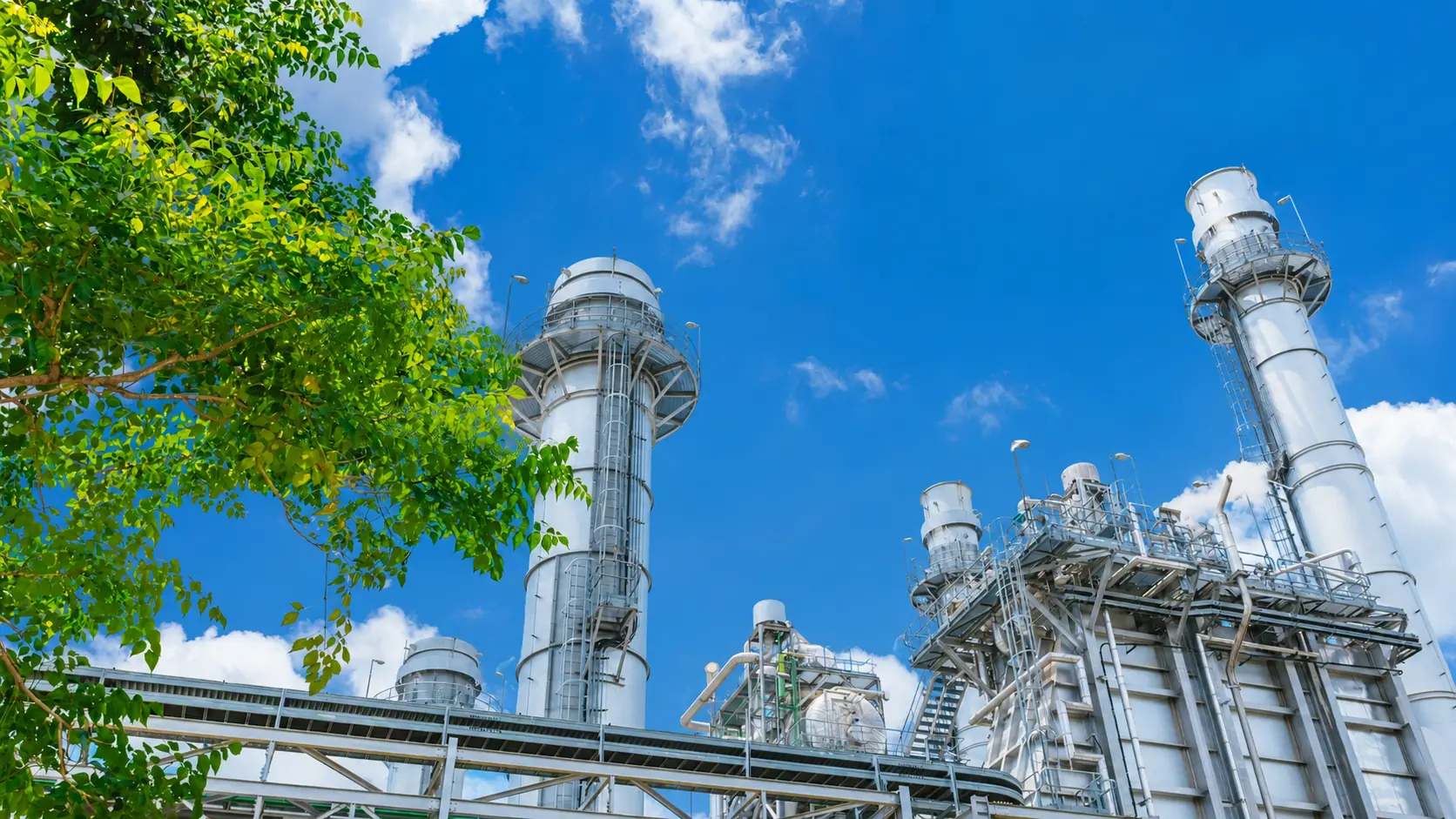
US–Thai global manufacturer · Made in Thailand · Delivered in 19 countries
Arrow Energy is a US–Thai global manufacturer of electrostatic precipitators (ESP), the proprietary Electrocyclone™ hybrid particulate collector, and boiler revamping and energy-efficiency solutions — 606 projects across 19 countries for sugar, biomass, cement, pulp and paper and power plants, engineered around each plant’s actual fuel, operating duty and compliance basis, from technical assessment through commissioning.
Design basis, not a measured result. Arrow Energy sizes electrostatic precipitator collecting area for a design collection efficiency of 99.9 % and a stack outlet below 10 mg/Nm³ at 7 % O₂, dry, on the fuel, gas volume and inlet loading stated in each project’s design basis. The figure guaranteed on any given project is the one written into that contract, against the reference conditions that contract defines. Measured results are published in the project reference database on a stated basis — sampling method, reference O₂ and the standard applied — and are not interchangeable with this design figure.
02 — Selected industrial references
Selected customer and project relationships across sugar, biomass, power, cement, paper and process industries.







03 — Core technology platforms
Each platform explains where it fits, the operating inputs that govern selection, and the evidence required before a performance figure is published.
Selection starts with actual gas flow, temperature, moisture, particle-size distribution, ash chemistry, resistivity behavior and gas distribution. Effective migration velocity is validated for the project basis.
A proprietary first-stage separator intended to reduce the particulate duty reaching the downstream collector. Geometry, electrical configuration and performance must follow Arrow-approved engineering data.
Feedwater heating from backpass gas, engineered around gas-side fouling, water-side pressure, corrosion margin, approach temperature and the existing boiler heat balance.
Combustion-air heating with cold-end metal temperature evaluated from the gas/air heat-transfer coefficients, fuel chemistry and acid-dewpoint margin—not from a simple arithmetic average.
Superheaters, water walls, headers and tube bundles engineered from verified operating conditions, approved drawings, material-temperature limits and the applicable pressure-part code.
Fan selection reconciles the clean and fouled system-resistance curves, operating range, gas density, control method, motor reserve, erosion allowance and the required draught margin.
04 — The flue-gas path
This interactive schematic shows the engineering relationship between the boiler, heat recovery, first-stage separation, ESP, ID fan and stack. The numerical dataset is an illustrative worked example on a stated basis — not a project reference or a guarantee. Select a stage.
26.1 t/h bagasse fired on a spreader / travelling grate. Fly-ash carryover from the grate is 0.65–0.85 of the ash in the fuel, plus unburnt carbon — which is why raw dust leaving the furnace sits at thousands of mg/Nm³, not hundreds.
| # | Stage | Function | Key design figures | Dust out |
|---|---|---|---|---|
| 1 | Furnace & grate | Combustion; fly-ash carryover | 26.1 t/h fuel · 105 100 Nm³/h | 6 000 mg/Nm³ |
| 2 | Superheater | Steam temperature control | 60 t/h steam · cp 1.20 kJ/kg·K | 6 000 mg/Nm³ |
| 3 | Economizer | Feedwater heating | 598 m² · 4.61 MW | 6 000 mg/Nm³ |
| 4 | Air preheater | Combustion-air heating | 4.16 MW · air 75 → 215 °C | 6 000 mg/Nm³ |
| 5 | Electrocyclone | First-stage bulk separation | 3 × Ø3.2 m · 16.5 m/s · d₅₀ 21 µm · Δp 83 mmWC | 720 mg/Nm³ |
| 6 | Electrostatic precipitator | Final collection | 3 888 m² · SCA 75.7 s/m · 4 fields · w 4.5 cm/s | 24 mg/Nm³ |
| 7 | ID fan | Draught | 270 mmWC · 177 kW shaft · 250 kW motor | 24 mg/Nm³ |
| 8 | Stack | Dispersion | Ø2.1 m × 45 m | 24 mg/Nm³ |
Without the Electrocyclone, the same duty and the same outlet figure need 6 309 m² of collecting area across six fields. With it, the ESP is 3 888 m² across four — 38 % less collecting area and about 9 m less casing length, on the same guarantee.
A two-field ESP is not guarantee grade. On this design, four fields give 24 mg/Nm³ — but with one field out of service it is 57 mg/Nm³. That is the number that matters during a campaign, and it is the one we design to.
05 — Industries served
Ash chemistry, resistivity and carryover differ by an order of magnitude between bagasse, rice husk and cement kiln dust. Every industry page starts from the fuel, not from the equipment.
06 — Featured engineering results
Filterable by industry, technology, region, fuel, capacity band and year. Every project carries the same nine fields, and every result says whether it was measured on a witnessed stack test or is a design basis.
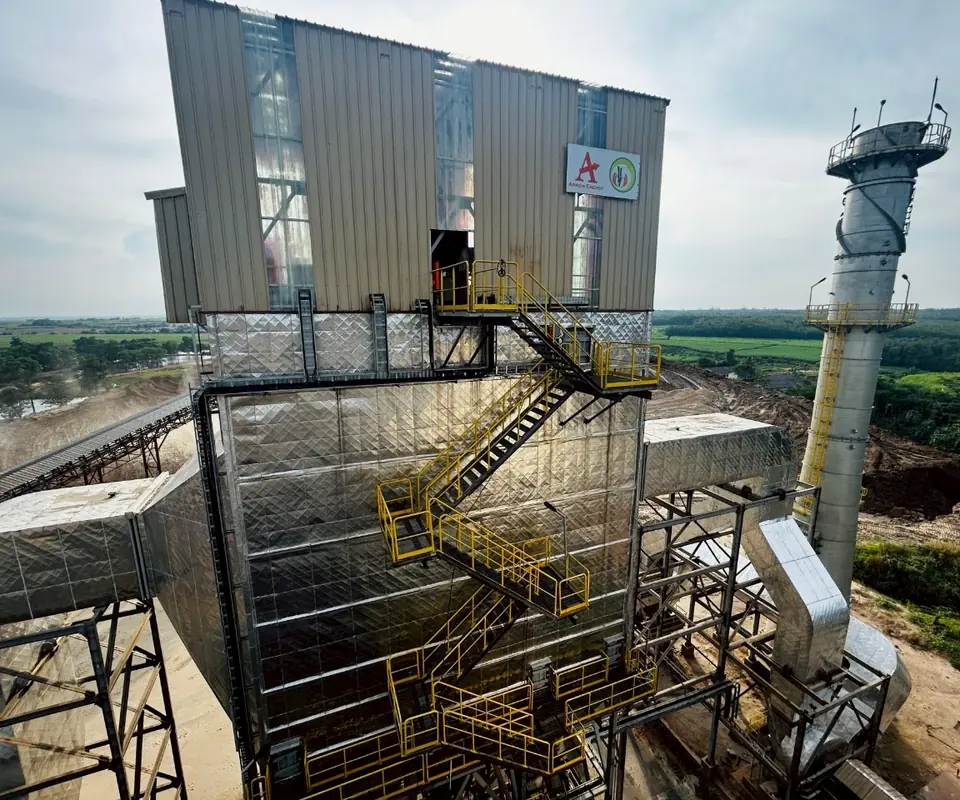
Bagasse boiler with a Gen-1 Electrocyclone and ESP train in commercial operation on mixed agro-residue — bagasse, rice husk, palm shell and cassava.
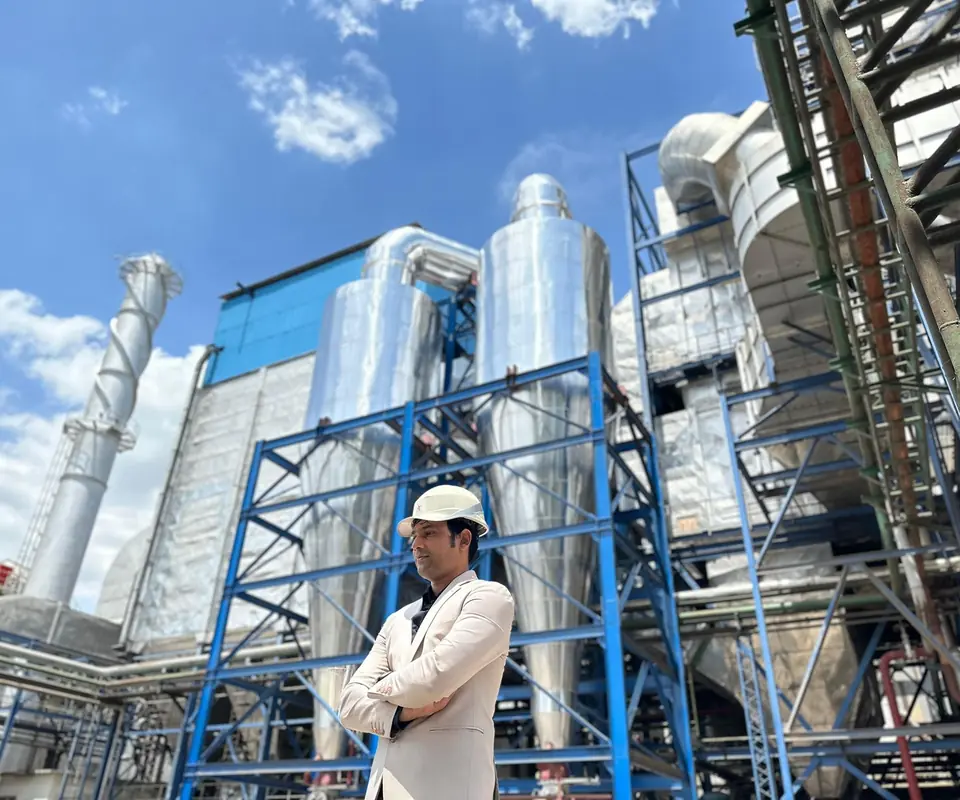
Electrocyclone for the largest unit of its type in Thailand — under construction, not yet in commercial operation.
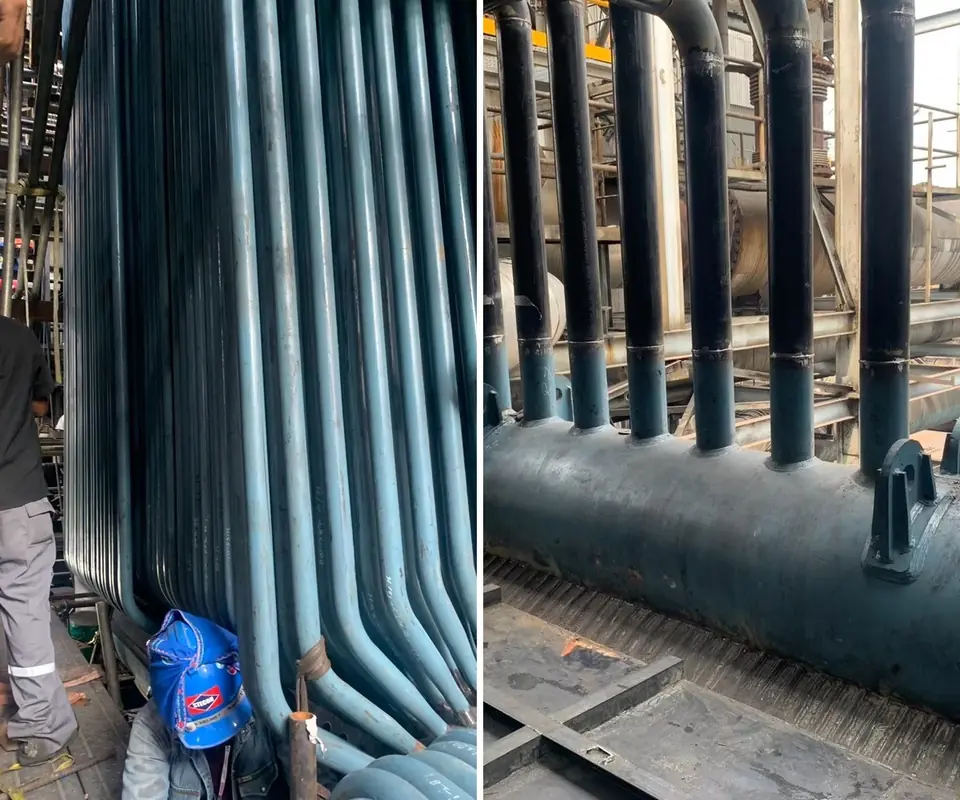
Boiler revamp — new bank tube assembly and header with welded tube stubs, fabricated in Samut Sakhon to the applicable pressure-part code with mill-certificate traceability.
Project results are published only after the customer identity or confidentiality treatment, plant status, scope and measurement basis have been approved. The full register is on the project references page.
07 — Proprietary technology
A mechanical and an electrostatic stage in one vessel. The cyclone body takes the bulk load by inertia; the charged core collects what inertia cannot reach. Everything downstream is then sized for what is actually left — which is where the cost comes out.
08 — Global footprint
Group entities and delivery presence. Project pins are drawn from the same records that render the project database — one dataset, two views.
Head office Bangkok and factory & R&D Samut Sakhon, Thailand · Arrow Energy USA LLC, Winston-Salem, NC · PT Arrow Energy Indonesia, Jakarta · Arrowrise Energy Pvt. Ltd., India · Arrow Energy Brazil LTDA. Project pins are indicative of delivery regions, not a count.
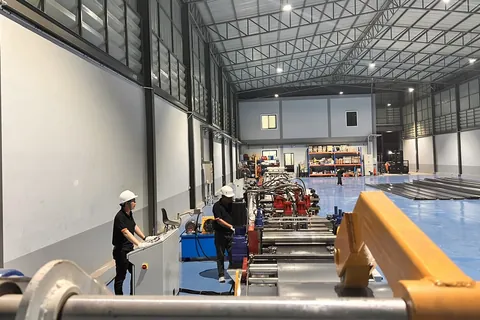
09 — Manufacturing and engineering
“Owning the factory is not a marketing point — it is what lets us commit to a shutdown date.”
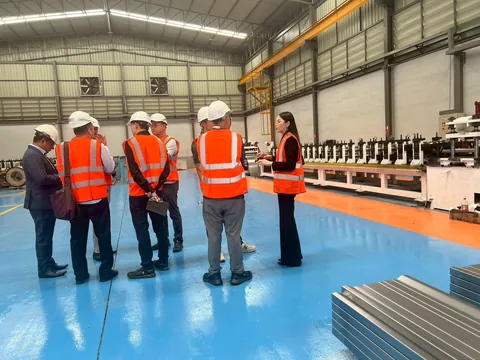
One engineering organisation, one design basis, one accountable partner — with the commercial and technical interface in your region and the fabrication shop under our own roof.
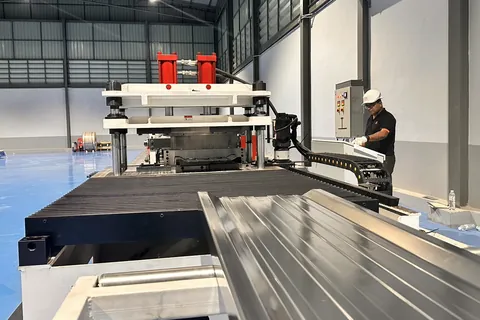
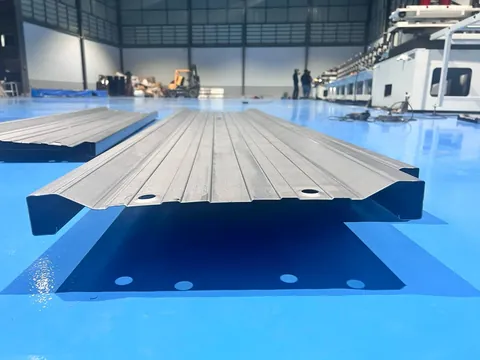
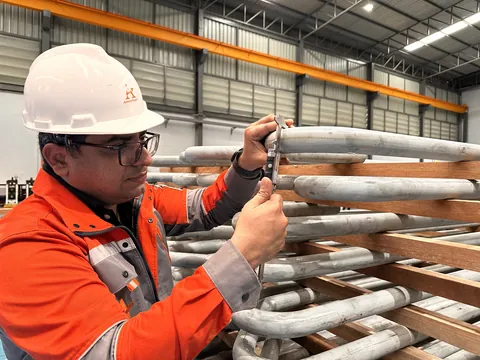
Inside the shop — collecting electrode manufacturing, Samut Sakhon
10 — Retrofit and lifecycle services
Each service states a typical outage window and a scope boundary — the two things a plant manager needs before they can raise it internally.
11 — Carbon and decarbonisation
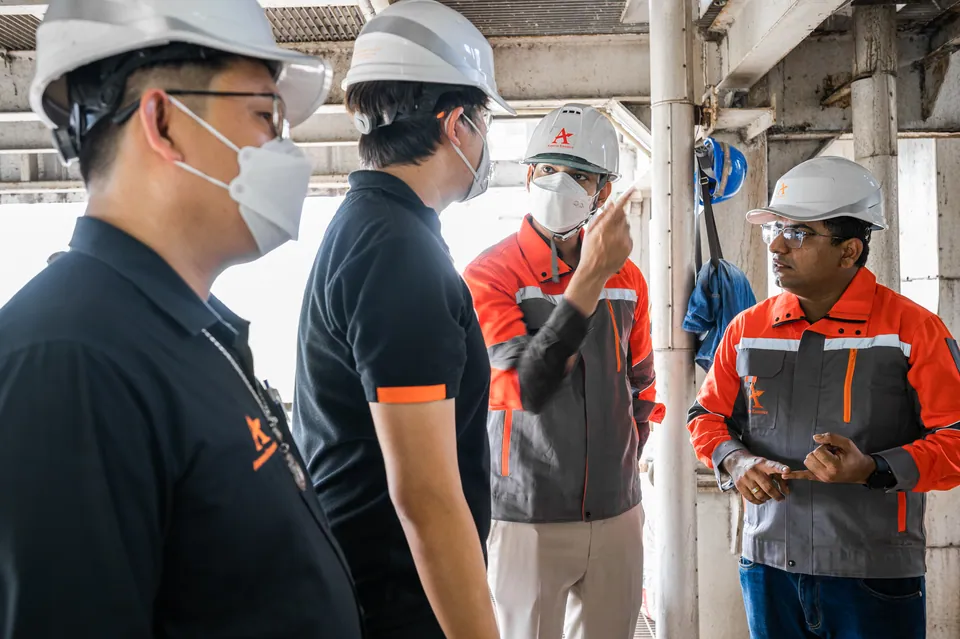
Our decarbonisation argument is fuel saved and heat recovered, measured on the plant. Where a technology is still in development we say so on the page.
12 — Technical resources
Written by Arrow engineers, on their own pages, so a specifying engineer — or the assistant they are researching with — can read and quote it. Not a PDF wall.
Three browser tools that return a working figure — and end with “send this configuration to our engineers”, which pre-fills the enquiry with what you entered.
Every download states format, size and language, so you know what you are clicking.
13 — Engineering questions, answered
Direct answers, each self-contained, each carrying its numbers. The same answers are published as structured data for answer engines.
Arrow Energy Co., Ltd. designs, manufactures and commissions electrostatic precipitators, the proprietary Electrocyclone pre-collector, bag filters, boiler pressure parts, economizers, air preheaters and flue-gas treatment systems, with fabrication at its Samut Sakhon factory in Thailand and delivery through assessment, engineering, installation, commissioning and spares.
From project gas data, not catalogue ratings: gas flow, temperature, moisture, particle-size distribution, ash chemistry and resistivity. Collection area follows from the Deutsch-Anderson relation corrected by Matts-Öhnfeldt (k ≈ 0.5). The homepage design basis — a 60 t/h bagasse boiler at 6,000 mg/Nm³ — needs SCA 75.7 s/m and 3,888 m² of collecting area for 24 mg/Nm³ at 7 % O₂ dry.
The Electrocyclone is a proprietary hybrid particulate pre-collector developed by Arrow Energy that combines cyclonic separation with electrostatic augmentation. It removes 85–95 % of particulate load ahead of an ESP or bag filter, operates up to 450 °C, absorbs 120–140 kW on a mid-size duty, and occupies 60–65 % of the footprint of an equivalent ESP stage.
Guaranteed figures are stated per project, after a technical assessment, on a defined basis: mg/Nm³ at a stated reference O₂, dry or wet, over a stated load range. The figures on this page are an internally consistent design basis for a worked example — they are labelled as such and are not a guarantee.
Fuel type and moisture, boiler capacity in t/h, flue-gas flow in Nm³/h, gas temperature, current emission in mg/Nm³ with its reference O₂, and the limit you must meet. With a fuel analysis and a recent emission test attached, an Arrow engineer can return an assessment basis rather than a brochure.
Arrow Energy Co., Ltd. is headquartered in Bangkok, Thailand, with its factory and R&D centre in Samut Sakhon, where ESP collecting electrodes, discharge electrodes, casings and boiler pressure parts are fabricated in-house. Arrow Energy USA LLC in Winston-Salem, North Carolina, coordinates projects in the Americas, with regional entities in Indonesia, India and Brazil. Arrow Energy is not affiliated with Arrow Energy Pty Ltd of Australia.
The Electrocyclone™ is a first-stage collector: it removes 85–95 % of the inlet dust by combined centrifugal and electrostatic action at up to 450 °C, so the downstream ESP or bag filter is sized for a fraction of the raw load. It is selected where inlet loadings are high — bagasse, rice husk and other biomass ash — and where the outlet limit still requires a final ESP stage. On its own it is not a guarantee-grade final collector for limits below about 50 mg/Nm³.
Yes. Arrow Energy USA LLC handles engineering coordination, contracts and site support for North America, and Arrow Energy has delivered ESP and Electrocyclone™ projects in Colombia, Brazil and Mexico with Spanish- and Portuguese-speaking engineers. Equipment is manufactured in Thailand and shipped with third-party inspection where the contract requires it.
14 — Engineering consultation
Boiler make and capacity, fuel, existing pollution control, current outlet, target limit and your next shutdown window. Attach the drawing, the fuel analysis or the stack-test report — we will not ask you to email it separately.