
45–110 kV
Operating voltage (negative DC)
ESP components · Emission side
Discharge electrodes are the high-voltage emitters of an ESP: energised at negative 45–110 kV, their sharp points ionise the gas and feed corona current of typically 0.1–0.5 mA per metre of electrode. The choice between rigid frame, spiral and barbed wire sets emission, dust-load tolerance and breakage risk.
01 — Function
No corona, no charge; no charge, no collection — the emitter is where the machine starts.
In electrostatic precipitator design, the discharge electrodes are the negative high-voltage elements centred in each gas passage between the earthed collecting electrodes. Fed at 45–110 kV DC from the field's transformer rectifier set, their sharp features — barbs, spikes, small-radius wire — push the local surface field above the corona onset of roughly 30 kV/cm and sustain a glow discharge that fills the passage with negative ions. Dust crossing the passage picks up that charge and migrates to the plates.
The working measure of an emitter is its corona current per metre of electrode length: typically 0.1–0.5 mA/m in service, set by geometry (tip radius, barb pitch), gas conditions and dust space charge. Total electrode length in a field, times this figure, must supply the current density the dust needs at the plate — the same 0.3–0.7 mA/m² of collecting area that sizes the TR set. Too little emission starves the field; too much, concentrated at few points, wastes power in localised streamers and invites back-corona on high-resistivity ash.
The quantities involved are worth holding in mind: a single design-basis field of 972 m² of plate, targeting 0.3–0.7 mA/m², needs roughly 300–680 mA of corona current, supplied by some 1.5–3 km of installed electrode length emitting 0.1–0.5 mA/m. A few percent of that length failing — corroded tips, broken elements clipped out and never replaced — is a measurable loss of charging capacity in the field where it happens.
02 — Types
Three geometries dominate; each trades emission control against mechanics and cost.
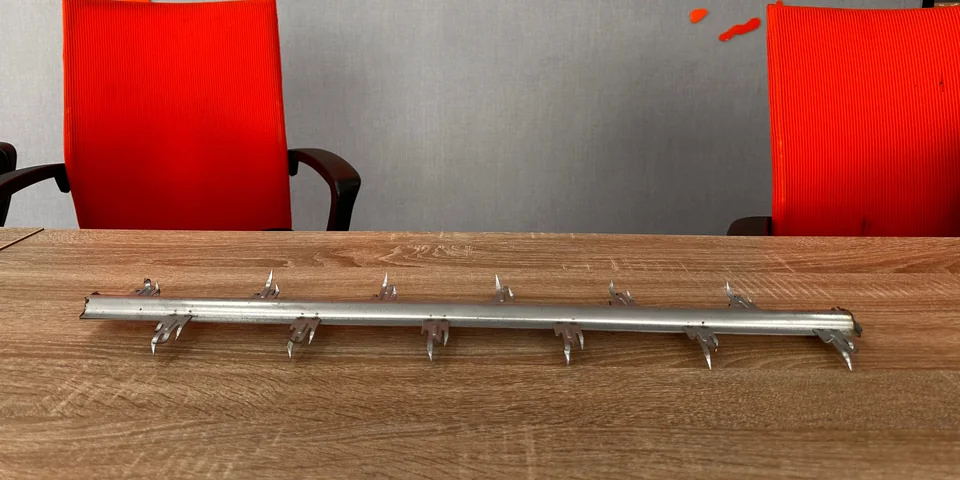
A rigid-frame discharge electrode is a stiff steel mast carrying fixed emitter spikes at a set pitch, so every emission point is defined by the drawing rather than by how a wire hangs. The section photographed is an Arrow Energy spike-type element as manufactured at Samut Sakhon: a cold-formed steel profile with multi-point spike clusters along its length — the geometry behind the 0.2–0.5 mA/m in the table below.
Spike pitch is the design variable. Closer pitch raises corona current per metre for high-resistivity ash that needs controlled charging; wider pitch limits current where back-corona is the risk. Because the mast has no free span, it takes hard rapping without oscillation and holds the ±5 mm centring in the gas passage that fixes the clearance to the collecting electrodes.
It is the default for tall fields (10–15 m) and heavy dust loads, and the usual conversion target when a weighted-wire or spiral ESP is retrofitted for higher current per metre or lower breakage — see section 04 for the selection rules.
| Type | Construction | Emission character | Corona current | Mechanical behaviour | Typical duty |
|---|---|---|---|---|---|
| Rigid frame (mast + spikes) | Pipe or profile mast frame carrying fixed emitter spikes or serrated strips | Uniform, defined emission points; current density controllable by spike pitch | 0.2–0.5 mA/m | Stiff, tolerates hard rapping; no free spans to oscillate | High dust loads, tall fields 10–15 m, high-resistivity ash needing controlled current |
| Spiral | Helical spring of 2.7–3.0 mm wire, tensioned by its own elasticity between top and bottom frames | Continuous emission along the small-radius wire; good corona at moderate voltage | 0.1–0.4 mA/m | Self-tensioning, forgiving of thermal growth; limited rapping-energy tolerance | Biomass and general duty at 300–400 mm spacing; cost-effective renewals |
| Barbed wire / serrated strip | Straight wire or strip with pressed barbs at fixed pitch, mounted in frames | Strong point emission at the barbs; higher current at given kV than plain wire | 0.2–0.5 mA/m | Depends entirely on frame support and anti-sway anchorage | Retrofit of weighted-wire ESPs; duties wanting high current per metre |
| Weighted straight wire (legacy) | Plain 2.5–3 mm wire hung with a cast tensioning weight | Weak, uncontrolled emission from a smooth surface | 0.05–0.2 mA/m | Free span oscillates; the highest breakage rate of any type | Legacy units only — the standard candidate for type conversion |
Material follows the ash. Carbon steel serves standard biomass and coal duty at ≤ 200 °C. Where fuel chlorine is high — palm residues, waste co-firing — pitting on a 2.7 mm spiral removes proportionally far more section than on a 1.5 mm plate fold, so stainless 304/316L emitters are the usual upgrade; the emitting tips must stay sharp, because a corroded, rounded barb measurably drops corona current per metre.
03 — Failure
One broken electrode takes down one field — in a small ESP, that is a quarter of the machine.
Fatigue at points of restrained movement — above all the anti-sway anchorage at the bottom frame, where rapping and aerodynamic oscillation cycles concentrate. Spark erosion is the usual crack initiator: a misaligned electrode sparks repeatedly at one spot, each arc melts a micro-notch, and the notch becomes the fatigue origin.
The failure chain is worth tracing because it decides the fix. Misalignment beyond the ±5 mm centring tolerance moves one emitter closer to a plate; the voltage controller now sparks at that spot at every ramp, hundreds of times per hour. Sparking erodes the electrode locally while cyclic loads — discharge-frame rapping, vortex-driven wire oscillation, thermal growth against a seized guide — work the notch. When the electrode parts, it swings onto the plate and earths the bus section: the TR set sees a dead short and the field is lost until someone enters the casing and clips the remnant out. Under the n−1 arithmetic of a four-field ESP, that single 3 mm wire moved design-basis outlet dust from 24 to 57 mg/Nm³.
Secondary causes cluster at the top of the machine: dust build-up on shaft and support insulators tracks to earth and mimics electrode faults, and broken anti-sway insulators leave the whole discharge frame swinging — after which electrode breakage becomes serial rather than singular. A breakage log that names positions, not just counts, usually points straight at the mechanical root cause.
04 — Retrofit selection
Renewal is the one cheap opportunity to correct the original selection.
Change type when the electrode itself is the weak point: chronic weighted-wire breakage justifies conversion to rigid frames or spirals, and high-resistivity ash running in back-corona benefits from mast-and-spike frames with wider spike pitch to cap current density. Keep the type — and fix alignment, rapping or insulators instead — when failures trace to mechanics around the electrode.
Two conversions recur in practice. First, weighted wire to rigid frame or spiral: it removes the free span that oscillates, typically ends serial breakage outright, and raises attainable mean kV because emission is uniform rather than concentrated at damage sites. It requires new top and bottom frame hardware, so it is an outage-scope job best combined with a plate survey. Second, emission tuning on resistive ash: dry rice-husk silica or low-sulphur coal ash near the 10¹¹ Ω·cm limit does not want more current — it wants controlled current, evenly spread, at the highest voltage the gap allows. Fixed-spike frames sized for 0.1–0.2 mA/m in the outlet field, paired with modern voltage control, do that; a high-emission barbed geometry there simply feeds back-corona.
Electrode sets are dimensional replacement parts: from frame drawings or site measurement we manufacture emitters interchangeable with other makers' internals, matched to the existing suspension, rapping and TR characteristics — normally scoped together with collecting electrodes under an ESP upgrade, since the two sides of the passage age together and are surveyed to the same ±5 mm at closure.
FAQ
It creates the corona that makes precipitation possible. Held at negative 45–110 kV, sharp points and edges raise the local field above roughly 30 kV/cm, ionising the gas. The resulting ion current — typically 0.1–0.5 mA per metre of electrode — charges dust particles so the field drives them to the collecting plates at 2–15 cm/s.
Rigid frames with fixed emitter spikes give controlled, uniform emission and survive heavy rapping — the default for high dust loads and taller fields. Spirals of 2.7–3.0 mm wire are cheap, self-tensioning and emit well, but tolerate less rapping energy and misalignment. Weighted straight wire is largely obsolete: highest breakage rate, weakest emission control.
Almost always fatigue, not corrosion. A wire or spiral that can oscillate cracks at its anti-sway anchorage after millions of rapping and aerodynamic load cycles; misalignment concentrates sparking at one spot, and each spark erodes a notch that becomes the crack starter. One broken electrode earths the whole bus section — the field trips until it is removed.
Carbon steel is standard below 200 °C on biomass and coal ash duty. Stainless grades such as 304 or 316L resist chloride pitting on palm-residue and waste fuels, where a 2.7 mm carbon-steel spiral loses section quickly. Emitter points must stay sharp — corrosion that rounds a barb tip measurably cuts corona current per metre.
Change type when the failure history says the type is wrong: repeated wire breakage in a weighted-wire ESP justifies conversion to rigid frames or spirals, and mast-and-spike frames suit high-resistivity dust needing controlled current density. Keep the type when breakage traces to alignment or rapping faults — new geometry will not fix a mechanical root cause.
Fuel, boiler capacity, gas flow, current emission and the limit you must meet. An Arrow engineer replies with a technical assessment basis — not a brochure.